Information on the Buddha head statue owned by the Berlin art collector Johanna Hansi Share, widowed Ploschitzki
June 10, 2024
Jana C. Reimer, Provenance Researcher on Nazi-looted property
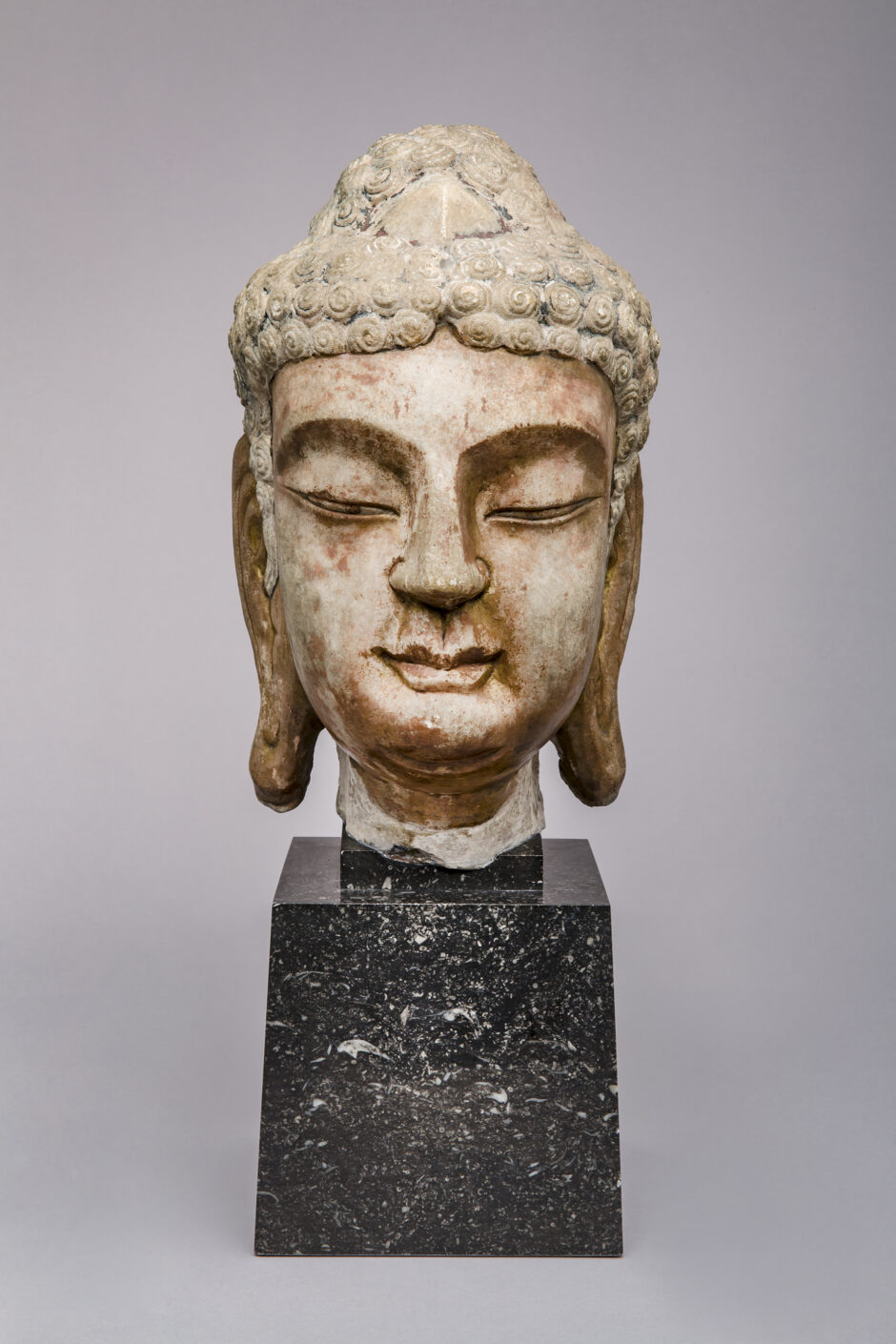
Object description: Head of a Buddha figure (fragment)
Provenance: probably China [recorded as India when it entered the museum]
Production period: 14th-17th century (or later)
Material: Marble, color pigments; mounted
Dimensions: Height: 29.2 cm, with base 45 cm; Width: 17 cm; Depth: 22 cm
Weight: 20 kg
This depiction of a Buddha is a fragment of a full-body sculpture. The head shows some of the so-called “beauty features” of the Buddha, such as three neck folds, long earlobes, the shining forehead mark urnâ and the skull outgrowth ushnîsha. The lack of other attributes makes a more precise identification difficult. It is possible that the founder of the religion, Gautama Siddharta, is depicted here after attaining Buddhahood. Images of Buddhas are displayed as role models in temples and on domestic altars. The size of the head indicates that the statue was located in a temple.[1]
The exact origin and dating of this head statue have not yet been investigated in depth.
Restitution case of Johanna Hansi Share, registered Fehr[DA1] , widowed Ploschitzki, née Zender
born 1887 in Berlin, died 1981 in Los Angeles, CA, USA
Biographical information on Johanna Hansi Share
The art collector Johanna (Hansi) Ploschitzki lived in Berlin with her husband Hermann Ploschitzki (1872-1932) and two daughters.
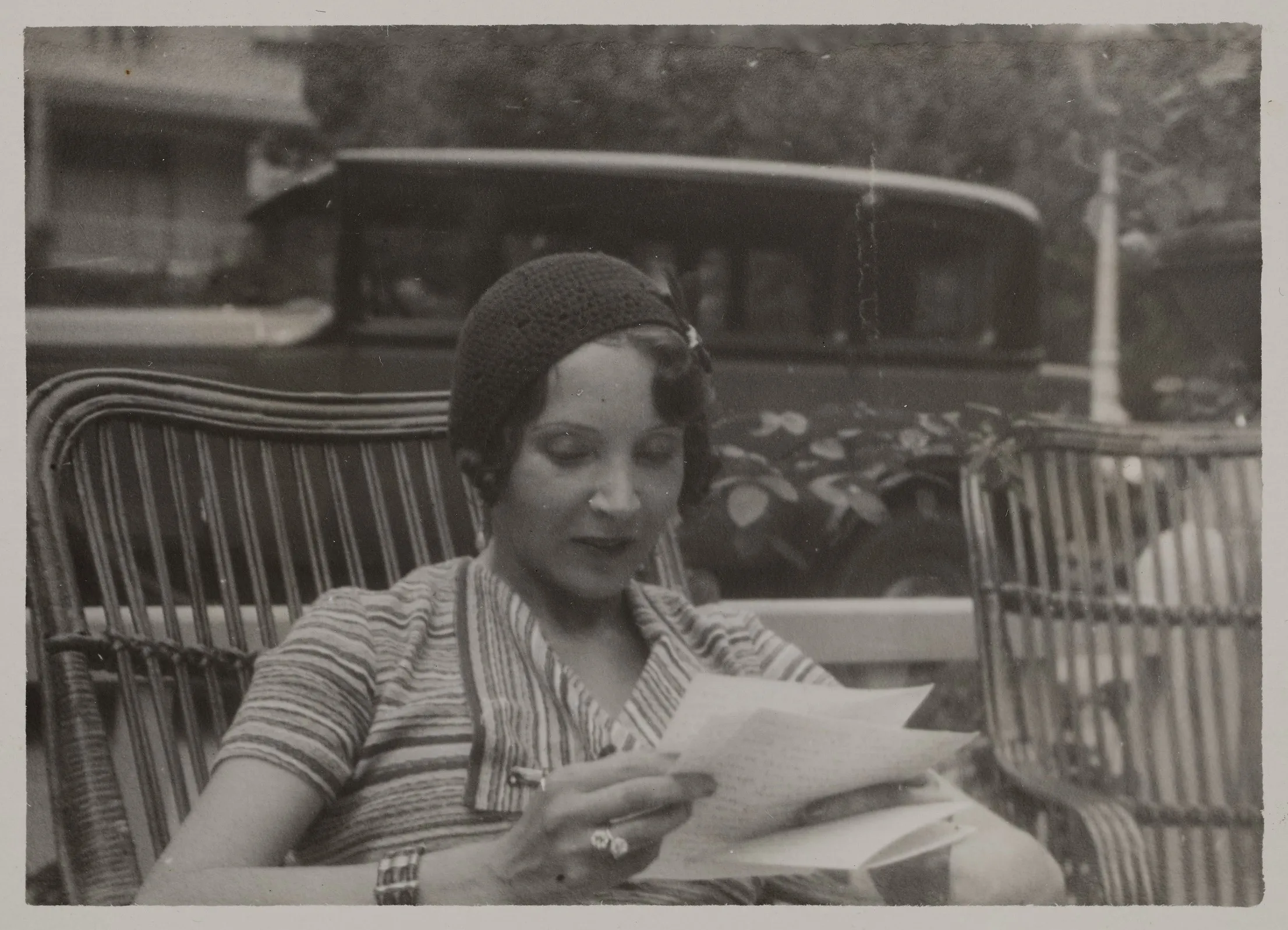
Johanna Hansi Ploschitzki. Photographer unknown. Berlin (?), 1920s
Credits: Hansi Share papers, Collection no. 6160, Special Collections, USC Libraries, University of Southern California
Hermann Ploschitzki was co-owner of a department store later known as Karstadt in Potsdam.[2] After his death in 1932, his assets were passed to Johanna Ploschitzki as his first heir. This included the villa they had jointly designed for her in Berlin Dahlem at the end of the 1920s, as well as an extensive and prominent art collection. After the transfer of power to the National Socialists in 1933, Johanna Ploschitzki and her family were affected by National Socialist persecution due to their Jewish origins. In 1936, the Reich Press School was housed in the Dahlem villa.[3]
A second marriage in 1933 to the Swiss painter Julius Wilhelm Fehr ended in divorce in 1934 and Johanna Ploschitzki once again took the surname she shared with her daughters.[4] Between 1935 and 1939, Johanna Ploschitzki appears to have traveled to the USA several times until remaining there permanently with her daughters from 1939 onwards.[5] In 1939 Johanna Ploschitzki also married the entrepreneur Leon M. Share in Los Angeles, California, her third marriage, and took the name Hansi Share.[6] She was granted US citizenship in 1945 and lived in Los Angeles until her death in 1981. [7]
In the early 1940s, Hansi Share set up the successful doll studio “Monica Dolls Studio” in Los Angeles, where she made dolls with real hair. Friedrich Kahn, who knew Hansi Share from her time in Berlin society in the 1920s, reported on the young company in the newspaper Aufbau in1945.[8]
National Socialist dispossession in the port of Hamburg in 1941
After leaving for the USA, Hansi Share’s personal belongings, which were intended for shipment, remained in nine crates in the port of Hamburg. As in many similar cases, Hansi Share’s belongings were confiscated by the Secret State Police in 1941 and the Hamburg bailiffs were instructed to auction off the art, furnishings and household items they contained.[9] The extensive minutes of the auction held by bailiff Heinrich Bobsien at the address Drehbahn 36 in early December 1941 are kept in the Hamburg State Archives. They document the individual items and the names of the buyers, including art dealers, private individuals and museums.[10] For the Hamburg Museum für Völkerkunde (now the MARKK Museum am Rothenbaum), the director at the time, Franz Termer, acquired a book collection for the library and seven art objects from East Asia with special funds from the authorities: six Tang ceramics and the head of a Buddha statue.[11]
Restitution proceedings in 1948 and Hamburg restitutions in 1951
In November 1948, the Berlin lawyer Dr. Helmut Ruge, representing Hansi Share, initiated restitution proceedings at the Central Office for Property Administration in Bad Nenndorf.[12] The entire legal proceedings lasted until the 1960s.[13] In December 1950, the Restitution Office in Hamburg ordered the restitution of the objects owned by Hansi Share that had been purchased by Hamburg museums in 1941. In February 1951, the Museum für Völkerkunde also handed over the six Chinese ceramics from the Tang Dynasty and the surviving book collection to Hansi Share. The Buddha head, however, remained in the Hamburg museum depot. [14]
Investigation: Why wasn’t the Buddha head returned in 1951?
The location of the sculpture in the museum was evidently due to incorrect information on the part of Hansi Share and her lawyer, as well as the museum’s withholding of relevant information. The copies of the original auction lists in the restitution proceedings files contained a transcription error: Item 626 “old head” had become “old pot” in the copy.[15] As a result, both government officials and lawyers formulated the claim for restitution to the museum accordingly.[16] Represented by the director Franz Termer and managing director Eduard Dennert, the museum had to formally confirm the otherwise correctly listed objects and books. In official correspondence, they repeatedly declared the item “old pot” to be “not identical”.[17] The museum file contains an internal review for this date and reference to corresponding complete lists of the collection in question, which list all the objects acquired at the auction in 1941 in full.[18] However, neither Franz Termer nor Eduard Dennert mention the Buddha head in the official correspondence of the proceedings. Instead, the museum management questioned the legality of the restitution claim, citing the assumed “voluntary nature” of the auction. An objection that the lawyer Helmut Ruge clearly refutes.[19]
Hansi Share and the tiresome search for her art collection
The official and formal restitution proceedings after 1945 were difficult and tedious for those affected and robbed, if they were even able to apply for them at all. They often dragged on for several years.[20]
The proceedings initiated by Hansi Share lasted until the 1960s. It is clear from the restitution files that Hansi Share was still trying to identify her art collection in 1960 based off the rudimentary information in the auction record. At this point, she was already seeking financial compensation, as most of the artworks were not returned to her. She assumed that the Buddha head, of whose whereabouts in the museum in Hamburg she had no knowledge, was in an item described as a “stone figure” that had been acquired by a private individual.[21] The fact that Hansi Share was referring to the head statue in the museum can be seen from a photograph enclosed in the file. The Buddha head can be seen in a picture taken of the library in her Berlin villa around 1930 .[22]
View of Johanna and Hermann Ploschitzki’s villa library in Dahlem. The Buddha head can be seen to the left of the fireplace. Photographer unknown, Berlin, around 1930
Credits: Hansi Share papers, Collection no. 6160, Special Collections, USC Libraries, University of Southern California
Hansi Share’s notes also contain an additional reference to the provenance of the head before 1933, a period that is yet to be researched for the Buddha head. She notes that, like many of her other East Asian art objects, she acquired it from the Wannieck art dealership in Paris. In the 1920s, East Asian art was very popular with Western collectors. Often labeled with the origin “Siam” (Thailand), heads of Buddha statues were for sale in large numbers.[23] The Parisian art dealer Wannieck specialized in this area and had connections to the Chinese art market.[24] Whether a case of looting and possible connection to colonial contexts applies here still needs to be examined.
Since 2019: In-depth research and provenance studies have been carried out at the MARKK
The MARKK began investigating the question of why and under what circumstances this head of a Buddha figure remained in the museum in fall 2019. At this time, two curators became aware of the Johanna Ploschitzki Collection and the associated Buddha head while preparing for the “Steppes & Silk Roads[DA3] ” exhibition. Of the seven objects, six were listed in the documentation as having been returned in 1951, but the Buddha head was not; it was still in the museum depot. In the following months, the obvious context of Nazi-looted property and Hansi Share’s biography were researched for the exhibition and published in the exhibition catalogue in 2020. In November 2019, MARKK was contacted for a research project on public auctions of Nazi-confiscated personal property in the Port of Hamburg, which was planned at the Bremerhaven Maritime Museum and funded by the German Lost Art Foundation. This inquiry about affected museum holdings at the MARKK led to the auction of Johanna Ploschitzki’s household effects becoming a central topic[DA4] .[25]
The exemplary significance of the auction of Hansi Share’s property and the subsequent restitution proceedings in the overall context of the restitution proceedings after 1945 was first made clear by the historian Jürgen Lillteicher in his dissertation in 2003.[26]
The Nazi-looted history of the Buddha head in the MARKK was investigated in depth in 2021 in a long-term provenance research project on Nazi-looted property in the MARKK collections, funded by the German Lost Art Foundation. Likewise, in 2021, the first inquiries were made to MARKK by the legal representatives of the Hansi Shares heirs’ association and, following the necessary reporting by the museum to the Hamburg Ministry of Culture and Media, formal restitution proceedings were initiated at the end of the year. Formal restitution to the heirs finally took place in 2024.
Recommended citation:
Reimer, Jana C. Provenance report on the head of a Buddha statue owned by the Berlin art collector Johanna Hansi Share, widowed Ploschitzki. Hamburg, 2024 URL: www.markk-hamburg.de/
Literature references:
Kahn, Friedrich “Hansi Share and her ‘MillionDollarBabeDoll’. The path of an immigrant to success and fame” In: Aufbau, 11th year, number 23, June 8, 1945, pages 16-17
Kleibl, Kathrin; “Bailiffs as art dealers?” In: Galler / Meiners (eds.)
Kiel, Susanne Regional art trade: A challenge for provenance research? Heidelberg 2022, pp. 270-346.
Lang, Maria-Katharina Steppes & Silk Roads. Wille, Rahel (ed.) Exhibition catalog MARKK Museum am Rothenbaum. Hamburg 2020
Looting, law and restitution. The Restitution of Jewish Property in the Early Federal Republic. Göttingen, 2007
Archive sources:
MARKK Archive
File Archive I – 861 Special permits from the Administration for Art and Cultural Affairs (1941-1951)
Hamburg State Archives
213-13_28997 Share, Johanna / Hansi, née Zander / Zender / Zenker, gesch. Fehr, widowed Ploschitki / Ploschitzki, 1950-1951: Parts 1, 2 and 5
214-1_566 Johanna Ploschitzki, Berlin. Home furnishings, art objects (some acquired from the Museum für Kunst und Gewerbe) (1941-1942(1947))
Sources on Ancestry.org:
Landesarchiv Berlin; Berlin, Germany; Register of births and marriages
Ancestry.com. Berlin, Germany, birth register 1874-1908 [database online].
Landesarchiv Berlin; Berlin, Germany; Marriage registers; Ancestry.com. Berlin, Germany, Marriage Register 1874-1936 [database online]
Landesarchiv Berlin; Berlin, Germany; civil status register death register
Ancestry.com. Berlin, Germany, death register 1874-1955 [database online].
Lehi, UT, USA: Ancestry.com Operations, Inc, 2014
The National Archives in Washington, DC; Washington, DC, USA; Passenger and Crew Lists of Vessels Arriving at New York, New York, 1897-1957; microfilm serial number or NAID: T715; Record Group (RG) title: Records of the Immigration and Naturalization Service, 1787-2004; RG: 85
Ancestry.com. New York, USA, Lists of arriving passengers and crews (including Castle Garden and Ellis Island), 1820-1957 [database online]. Lehi, UT, USA: Ancestry.com Operations, Inc, 2010.
California Department of Public Health, courtesy of www.vitalsearch-worldwide.com. Digital Images. Ancestry.com. California, U.S., County Birth, Marriage, and Death Records, 1849-1980
[database on-line]. Lehi, UT, USA: Ancestry.com Operations, Inc, 2017.
District Court, Los Angeles, California; Petitions, 1944 (Box 0361)
National Archives at Riverside; Riverside, California; Petitions for Naturalization, U.s. District Court For the Central District of California (Los Angeles), 1940-1991; NAI number: 594890; Record set title: Records of District Courts of the United States, 1685-2009; Record set number: 21; Ancestry.com. California, USA, federal naturalization records, 1888-1991 [database online]. Lehi, UT, USA: Ancestry.com Operations, Inc, 2014
Databases:
Kleibl, Kathrin & Kiel, Susanne. LostLift Database, German Maritime Museum – Leibniz Institute of Maritime History, 2024; https://lostlift.dsm.museum/ [06.06.2024]
[1] MARKK collection documentation; object description by the curator for the South and East Asia collection, Dr. Susanne Knödel, April 2024
[2] Kahn, Friedrich. “Hansi Share and her ‘MillionDollarBabeDoll'” In: Aufbau, 11th year, number 23, June 8, 1945, pages 16-17
[3] The house is no longer preserved today. “Johanna (Hansi) Share / Ploschitzki” In: Lang, Maria-Katharina, Wille, Rahel (eds.). Steppes & Silk Roads. Exhibition catalog MARKK Museum am Rothenbaum. Hamburg 2021. p. 127
[4] Landesarchiv Berlin; civil status register, marriage register, Dahlem registry office, 1933-1934 (first register), certificate no. 47; retrieved via ancestry.com [05.06.2024]
[5] In 1939, the most recent entry on a passenger list is for September 29 for the “Nieuw Amsterdam”, which sailed from Southampton to New York. The National Archives in Washington, DC; Passenger and Crew Lists of Vessels Arriving at New York, New York, 1897-1957; NAID: T715; RG: Records of the Immigration and Naturalization Service, 1787-2004; RG: 85; retrieved from ancestry.com [05.06.2024]
[6] Marriage register 1939, California; California Department of Public Health, courtesy of www.vitalsearch-worldwide.com. Digital Images; retrieved from ancestry.org [05.06.2024]
[7] District Court, Los Angeles, California; National Archives at Riverside, California; Petitions for Naturalization, U.S. District Court For the Central District of California (Los Angeles), 1940-1991; NAI number: 594890; Records of District Courts of the United States, 1685-2009; RNo: 21; retrieved from ancestry.org [05.06.2024]
[8] Kahn, Friedrich. “Hansi Share and her ‘MillionDollarBabeDoll'”
[9] Letter from the Secret State Police, Hamburg State Police Headquarters, to the bailiff’s office at the Hamburg District Court, Hamburg 31.10.1941. Hamburg State Archives, 214-1_566
[10] Minutes of the auction of Johanna Ploschitzki’s personal property, Hamburg Dec. 2-5 and 9, 1941. ibid.
[11] Letter from Hans Termer to the Administration for Art and Cultural Affairs of the Hanseatic City of Hamburg, Hamburg 2.12.1941. MARKK Archive I 861; excerpt from the South and East Asia item list, ibid.; invoice from Heinrich Bobsien to the Hamburg Museum für Völkerkunde, Hamburg 29.11.1941. Hamburg State Archives, 214-1_566. The invoice date of 29.11.1941 suggests that the museums had a right of first refusal.
[12] Claim for Restitution of Property: Dr. Helmut Ruge, Berlin for Johanna (Hansi) Share, widowed Fehr, née Zender, Hollywood, Ca., USA; Berlin 26.11.1948. Staatsarchiv Hamburg 213-13_28997 Part 2
[13] Landearchiv Berlin, B Rep. 025-03 Wiedergutmachungsämter von Berlin Geschäftsstelle 3, versch. Brandenburgisches Landeshauptarchiv, Oberfinanzpräsident Berlin-Brandenburg Rep. 36A (II): 36A (II) 29941 Ploschitzki, Hermann – estate, 36A (II) 29942 and 36A (II) 29943 Ploschitzki gesch. Fehr, Johanna
[14] List of objects seized in Hamburg museums. Wiedergutmachungsamt am Amtsgericht Hamburg to the Zentralamt für Vermögensverwaltung Bad Nenndorf, Hamburg 16.12.1949. Staatsarchiv Hamburg 213-13_28997 Part 2; notification of the court order to hand over the seized objects, Kulturbehörde der Hansestadt Hamburg to the Museum für Völkerkunde und Vorgeschichte, Hamburg 9.1.1951. MARKK Archiv I 861
[15] s. FN 10; typed copy of the original auction record, among others in Staatsarchiv Hamburg 213-13_28997 Part 2
[16] Letter regarding restitution claims from Johanna Ploschitzki, Restitution Office of the Hanseatic City of Hamburg to the Museum of Ethnology Hamburg, Hamburg 29.1.1949; letter from Helmut Ruge, lawyer to the Hamburg Museum of Ethnology and Prehistory, Berlin 25.10.1950. Both MARKK Archive I 861.
[17] Letter of reply from Eduard Dennert, Museum für Völkerkunde Hamburg to the Restitution Office of the Hanseatic City of Hamburg, 4.2.1948. The document contains the handwritten note “discussed with Prof. Termer”; letter of reply from Franz Termer to Helmut Ruge, Hamburg 1950. Both MARKK Archive I 861.
[18] Handwritten note with a note on books burned during the war-related removal and a list of all seven objects with the note “are available”. The six Tang ceramics are additionally marked with a check-mark, the “marble Buddha head” with a question mark, undated; on the letter from Helmut Ruge to the museum mentioned in FN 16, a handwritten note from the museum was added: “According to item list ‘East Asia C’, pot no. 626 was not purchased. gez, 31.10.50” However, the said item list lists the marble Buddha head in the complete inventory under inventory number 41.36:1. Both MARKK Archive I 861.
[19] s. FN 17
[20] For detailed information on the early restitution policy, see Lillteicher, Jürgen. The Restitution of Jewish Property in West Germany after the Second World War.
[21] Hamburg State Archives 213-13_28997 Part 1; the entry “A stone figure” bears the item number 625
[22] Hamburg State Archives 213-13_28997 Part 5
[23] cf. von Przychowski, Alexandra. “Buddhaköpfe und die Rezeption der chinesischen buddhistischen Kunst Anfang des 20. Jahrhunderts” In: Tisa Francini, Esther; Csernay, Sarah (eds.). Wege der Kunst: Wie die Objekte ins Museum kommen (exhib. cat. Museum Rietberg, Zurich), Zurich, 2022, pp. 335-350
[24] H. d’Ardenne de Tizac. “Leon Wannieck” In: Artibus Asiae. Vol. 4, No. 1 (1930 – 1932), p. 74; “Les Wannieck, un couple entre Paris e Pékin” Tokonoma Magazine online <https://tokonomamagazine.com/2019/07/26/les-wannieck-un-couple-entre-paris-et-pekin/> [06.06.2024]
[25] LIFTProv – Der Umgang mit Übersiedlungsgut jüdischer Emigranten in Hamburg nach 1939. Deutsches Schifffahrtsmuseum Bremerhaven, 2020-2025. <https://www.dsm.museum/forschung/wissenschaftsteam/liftprov-der-umgang-mit-uebersiedlungsgut-juedischer-emigranten-in-hamburg> [06.06.2024]; Kleibl, Kathrin & Kiel, Susanne. LostLift Database, German Maritime Museum – Leibniz Institute of Maritime History; <https://lostlift.dsm.museum/> [06.06.2024]
[26] s. FN 20